
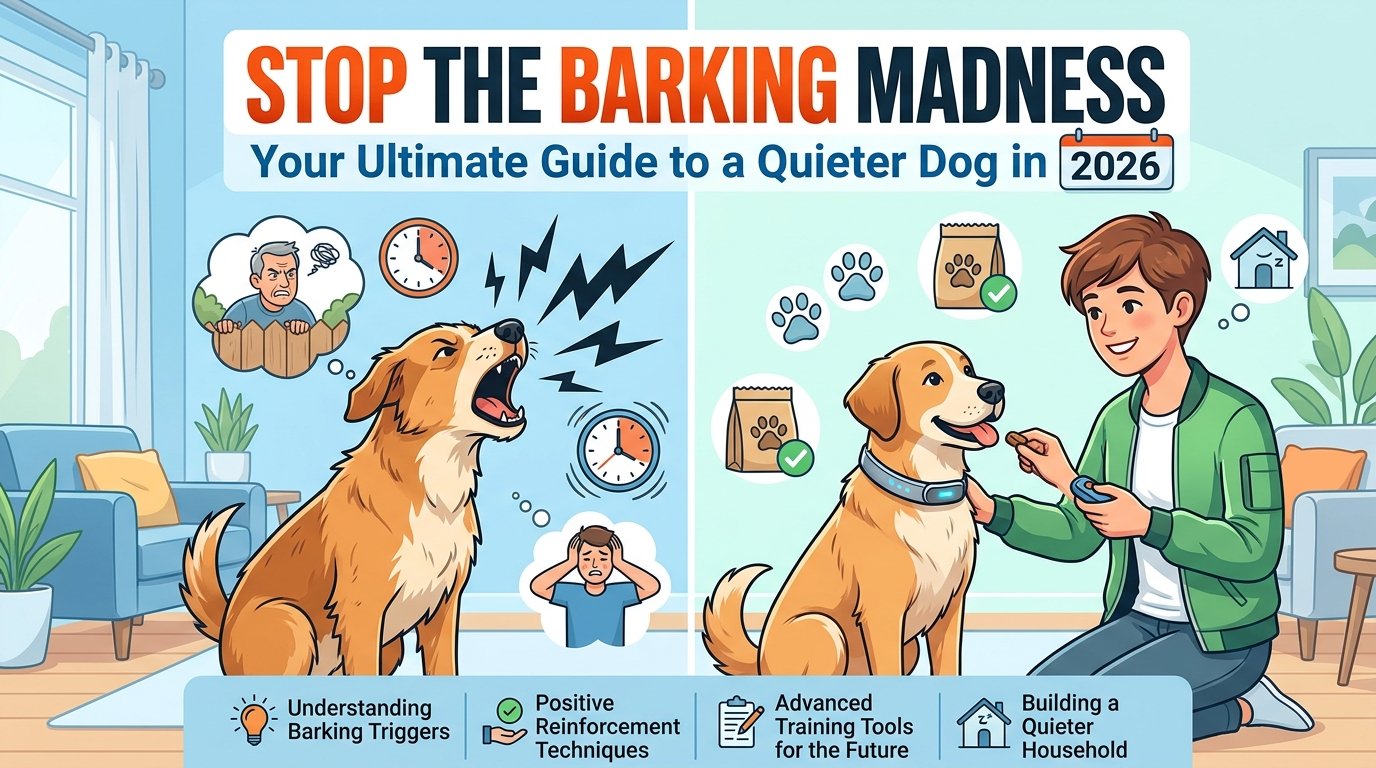
Tired of excessive dog barking? Discover effective strategies, training tips, and modern tools to quiet your dog in 2026. Reclaim peace in your home!
Life with a furry companion is filled with joy, laughter, and unconditional love. However, the relentless cacophony of excessive dog barking can quickly transform that joy into frustration, not just for you but for your neighbors as well. If you’ve ever found yourself wondering how to silence the constant clamor, you’re not alone. Many dog owners face the challenge of managing persistent dog barking, seeking solutions that truly work. The good news is that understanding the root causes and implementing targeted strategies can lead to a much quieter, happier household for everyone involved. It’s time to move beyond guesswork and embrace an ultimate guide to a quieter dog, ensuring peace reigns in your home well into 2026 and beyond.
Understanding Why Your Dog Barks: The Root Causes of Dog Barking
Dog barking is a natural form of communication for our canine friends, akin to how humans use speech. It’s their way of expressing emotions, needs, and reactions to their environment. However, when barking becomes excessive or inappropriate, it signals that something needs to be addressed. Understanding the underlying reasons is the first crucial step towards effective management of dog barking.
Communication, Not Annoyance
It’s vital to remember that your dog isn’t barking to intentionally annoy you. Instead, they are trying to tell you something. Whether it’s a plea for attention, a warning, or an expression of discomfort, each bark serves a purpose from the dog’s perspective. Our job as responsible pet owners is to decipher these messages.
Common Reasons Behind Excessive Barking
Several factors can contribute to persistent dog barking. Identifying the specific trigger is paramount to choosing the right training approach and ultimately resolving the issue. It’s often a combination of these factors that leads to what we perceive as uncontrollable barking.
Territorial or Protective Barking
Dogs often bark at strangers or other animals passing by their home or yard, viewing them as intruders. This type of dog barking is usually accompanied by an alert, rigid body posture and often occurs when the dog is on its own property. They are trying to warn off potential threats and alert their family.
Attention-Seeking Barking
Some dogs learn that barking gets them what they want – be it food, playtime, a walk, or simply a pet. They quickly associate their vocalizations with a desired outcome. This behavior often starts subtly but can escalate if consistently rewarded, even inadvertently, by owners who respond to the noise.
Boredom and Frustration Barking
A dog that isn’t sufficiently exercised or mentally stimulated may resort to barking out of sheer boredom or frustration. This is particularly common in high-energy breeds. They might bark at anything that moves, or even at nothing at all, simply because they have pent-up energy and no other outlet.
Fear and Anxiety Barking
Dogs that are fearful or anxious may bark at sounds, objects, or people that startle or intimidate them. This barking might be accompanied by tail tucking, cowering, or retreating. Loud noises, unfamiliar environments, or new people can trigger this kind of emotional response.
Greeting and Play Barking
When excited, some dogs will bark as a form of greeting to people or other dogs. This is often accompanied by a wagging tail, a relaxed posture, and an eager approach. While not typically problematic, it can become excessive if not managed, especially in social settings.
Separation Anxiety Barking
One of the most distressing forms of dog barking occurs when dogs are left alone. This type of barking is a symptom of separation anxiety and is often accompanied by other signs such as destructive chewing, house soiling, and pacing. The dog is genuinely distressed by being separated from its owner.
Identifying Different Types of Dog Barking and Their Triggers
Once you understand the general reasons why dogs bark, the next step is to pinpoint exactly what sets off your dog. This requires careful observation and a systematic approach. Each instance of dog barking is a piece of a larger puzzle.
Observing Your Dog’s Body Language
Your dog’s body language often provides clear clues about the motivation behind their barking. Pay attention to their posture, tail position, ear set, and facial expressions. A stiff body and forward ears might indicate territorial barking, while a low posture and tucked tail could signify fear. Loose, wiggly body language with a wagging tail typically points to excitement or play.
Keeping a Barking Journal
A “barking journal” can be an invaluable tool. For a few days or even a week, record every instance of dog barking. Note the time, duration, what triggered it (if identifiable), who was present, and what happened immediately before and after the barking started. Look for patterns:
– Does the barking occur only when you leave the house? (Separation anxiety)
– Is it only when someone walks past the window? (Territorial)
– Does it stop immediately when you give attention? (Attention-seeking)
– Is it worse after a day without much exercise? (Boredom)
This detailed record will help you identify consistent triggers and situations where dog barking is most prevalent, giving you a clear starting point for intervention.
Effective Training Strategies to Reduce Excessive Dog Barking
Addressing excessive dog barking requires consistency, patience, and the right training techniques. The goal is not to eliminate barking entirely, which is unnatural, but to teach your dog when and when not to bark, and to be quiet on command.
Positive Reinforcement: The Foundation of Success
Positive reinforcement is the most effective and humane method for training dogs. This means rewarding desired behaviors rather than punishing unwanted ones. When your dog stops barking, even for a moment, reward them immediately with a treat, praise, or a favorite toy. This helps them associate quietness with positive outcomes. Avoid yelling or punishing your dog for barking, as this can often increase anxiety or make them bark more.
Teaching the “Quiet” Command
One of the most practical strategies is to teach your dog a “Quiet” command.
1. **Trigger a bark:** Have someone knock on the door or ring the doorbell.
2. **Allow a few barks:** Let your dog bark 2-3 times.
3. **Introduce the command:** Say “Quiet!” in a firm, calm voice.
4. **Reward silence:** When your dog pauses barking, even for a split second, immediately give a treat and praise.
5. **Increase duration:** Gradually extend the period your dog needs to be quiet before getting the reward. Start with 1 second, then 2, then 5, and so on.
6. **Practice in different scenarios:** Once mastered in one setting, practice the “Quiet” command in various environments with different distractions.
This technique teaches your dog control over their dog barking and that silence, not noise, earns them rewards.
Desensitization and Counter-Conditioning
These techniques are particularly useful for dogs who bark due to fear, anxiety, or territoriality.
– **Desensitization:** Gradually expose your dog to the trigger at a low intensity, making it less frightening or exciting. For instance, if your dog barks at people walking by the window, start by having someone walk far away or in a distant part of the yard.
– **Counter-Conditioning:** Change your dog’s emotional response to the trigger from negative (fear, excitement) to positive. When the trigger appears (at a low intensity), immediately give your dog high-value treats or engage them in a favorite game. The idea is to make them associate the trigger with something pleasant.
Over time, your dog will learn that the presence of the trigger predicts good things, reducing the impulse for dog barking.
Managing Environmental Triggers
Sometimes, the simplest solution for excessive dog barking is to manage the environment.
– **Block the view:** For territorial barkers, block their view of outside triggers using opaque window film, curtains, or fences.
– **Sound masking:** Use white noise machines, radios, or TVs to mask outside noises that might trigger barking.
– **Create a safe space:** Provide a comfortable crate or a quiet room where your dog can retreat from overstimulating environments.
– **Limit access:** If your dog barks excessively when in the yard, supervise them or limit their time outside until training is effective.
By controlling the environment, you reduce opportunities for unwanted barking and create a calmer space for your dog.
Leveraging Technology: Smart Tools for Managing Dog Barking
In 2026, technology offers a range of innovative solutions to help manage and monitor dog barking. These tools can complement your training efforts, providing either immediate deterrents or valuable data for understanding your dog’s behavior.
A New Era of Barking Solutions
From smart collars to sophisticated home monitoring systems, modern gadgets provide various approaches to address excessive dog barking. These tools are designed to work in conjunction with positive reinforcement training, not as standalone fixes. They offer ways to interrupt barking, monitor patterns, or provide distractions when you’re not around.
Comparison of Top Barking Deterrent and Monitoring Gadgets
Choosing the right device depends on your dog’s specific barking triggers and your training philosophy. It’s crucial to select tools that are humane and used correctly to avoid causing stress or fear.
| Product | Price | Pros | Cons | Best For |
|---|---|---|---|---|
| Smart Bark Collar (Vibration/Citronella) | $60-$120 | Humane correction, can be effective for attention-seeking barking | Some dogs become accustomed to it; potential for misuse if set too high | Mild to moderate barkers needing gentle, immediate feedback |
| Ultrasonic Bark Deterrent Device | $30-$80 | Hands-free operation, wide coverage area, no physical contact | Effectiveness varies greatly by dog; sound can be irritating to some dogs and humans | Outdoor or indoor use for general nuisance barking when owners are not present |
| Smart Pet Camera with Two-Way Audio | $100-$250 | Monitor dog remotely, talk to them, dispense treats, record barking patterns | Does not directly deter barking; requires Wi-Fi and app | Monitoring separation anxiety, gathering data, providing remote reassurance |
| GPS & Activity Tracker with Barking Alerts | $100-$200 + Subscription | Tracks location & activity, sends alerts for excessive barking, provides insights into anxiety levels | Requires subscription; may not actively deter barking | Owners wanting comprehensive data on their dog’s behavior and whereabouts |
Considerations When Choosing a Device
When selecting a gadget, prioritize your dog’s comfort and well-being.
– **Effectiveness:** Does it address the specific type of dog barking your dog exhibits?
– **Humane Approach:** Does it use positive reinforcement or gentle deterrents, avoiding pain or fear?
– **Integration with Training:** Can it be used to support your training efforts rather than replace them?
– **Durability and Safety:** Is it well-made and safe for your dog to wear or interact with?
Always introduce new devices gradually and observe your dog’s reaction to ensure it’s not causing undue stress.
Creating a Calm Environment: Prevention and Long-Term Solutions
While specific training and tools can help manage dog barking, establishing a generally calm and enriching environment is crucial for long-term success. A well-adjusted dog is less likely to resort to excessive vocalization.
Enrichment and Exercise: Tired Dogs Bark Less
One of the most common reasons for excessive dog barking is a lack of physical and mental stimulation.
– **Daily Exercise:** Ensure your dog gets enough breed-appropriate exercise. This could be walks, runs, fetch, or playtime at a dog park. A physically tired dog is often a quiet dog.
– **Mental Stimulation:** Provide puzzle toys, interactive feeders, or engage in training sessions that challenge your dog’s mind. Mental fatigue can be just as effective as physical exercise in reducing boredom.
– **Chew Toys:** Offer appropriate chew toys to satisfy their natural chewing instincts and keep them occupied, especially when alone.
A dog with fulfilled needs is less likely to bark out of boredom or frustration.
Establishing a Consistent Routine
Dogs thrive on routine. A predictable schedule for feeding, potty breaks, walks, and playtime can significantly reduce anxiety and, consequently, dog barking. When dogs know what to expect, they feel more secure and are less likely to express distress through barking. Stick to a consistent daily schedule as much as possible.
Seeking Professional Help
If you’ve tried various methods and your dog barking continues to be a severe problem, don’t hesitate to seek professional help.
– **Certified Professional Dog Trainer (CPDT-KA):** A trainer can assess your dog’s behavior, identify specific triggers, and develop a customized training plan. They can also teach you advanced techniques and provide hands-on guidance.
– **Veterinary Behaviorist (Dip ACVB):** For complex cases, especially those involving anxiety, fear, or aggression, a veterinary behaviorist can offer medical insights and, if necessary, prescribe medication in conjunction with behavior modification. These specialists have a deep understanding of canine psychology and physiology.
Professional guidance can provide breakthroughs when you feel stuck, offering tailored solutions that might not be apparent to the average owner. They can also help distinguish between normal dog barking and more serious behavioral issues.
The journey to a quieter home for you and your dog is a marathon, not a sprint. It requires dedication, consistency, and a deep understanding of your dog’s needs and communication. By identifying the root causes of their dog barking, implementing humane training strategies, leveraging modern technology, and fostering a calm, enriching environment, you can significantly reduce excessive noise. Remember, a dog’s bark is their voice, and by learning to listen and respond appropriately, you strengthen your bond and ensure a harmonious household for years to come. Take these steps today, and look forward to a peaceful 2026 with your beloved canine companion.
For more insights or collaboration opportunities, visit www.agentcircle.ai.
Frequently Asked Questions (FAQ)
How long does it take to stop a dog from barking excessively?
The timeline varies greatly depending on the dog’s age, breed, the underlying cause of the barking, and the consistency of your training. Some dogs show improvement in a few weeks, while others with deeply ingrained habits or anxiety may take several months of dedicated effort. Patience and consistency are key.
Is it ever okay to use a shock collar for dog barking?
Most humane dog trainers and behaviorists strongly advise against using shock collars due to their potential to cause pain, fear, and anxiety, which can worsen behavioral issues. Positive reinforcement and gentle deterrents (like vibration or citronella collars, used sparingly) are generally preferred and more effective for long-term behavioral change.
My dog only barks when I’m not home. What should I do?
This often points to separation anxiety. Strategies include creating a safe den, gradually increasing alone time, leaving stimulating toys, and using smart cameras to monitor. For severe cases, consult a professional dog trainer or veterinary behaviorist, as medication might be considered alongside behavioral modification.
Can certain breeds be trained not to bark as much as others?
While some breeds are naturally more vocal than others (e.g., Beagles, Terriers), any dog can be taught to manage their barking with consistent training and proper environmental management. It might take more effort for highly vocal breeds, but it’s certainly achievable.