
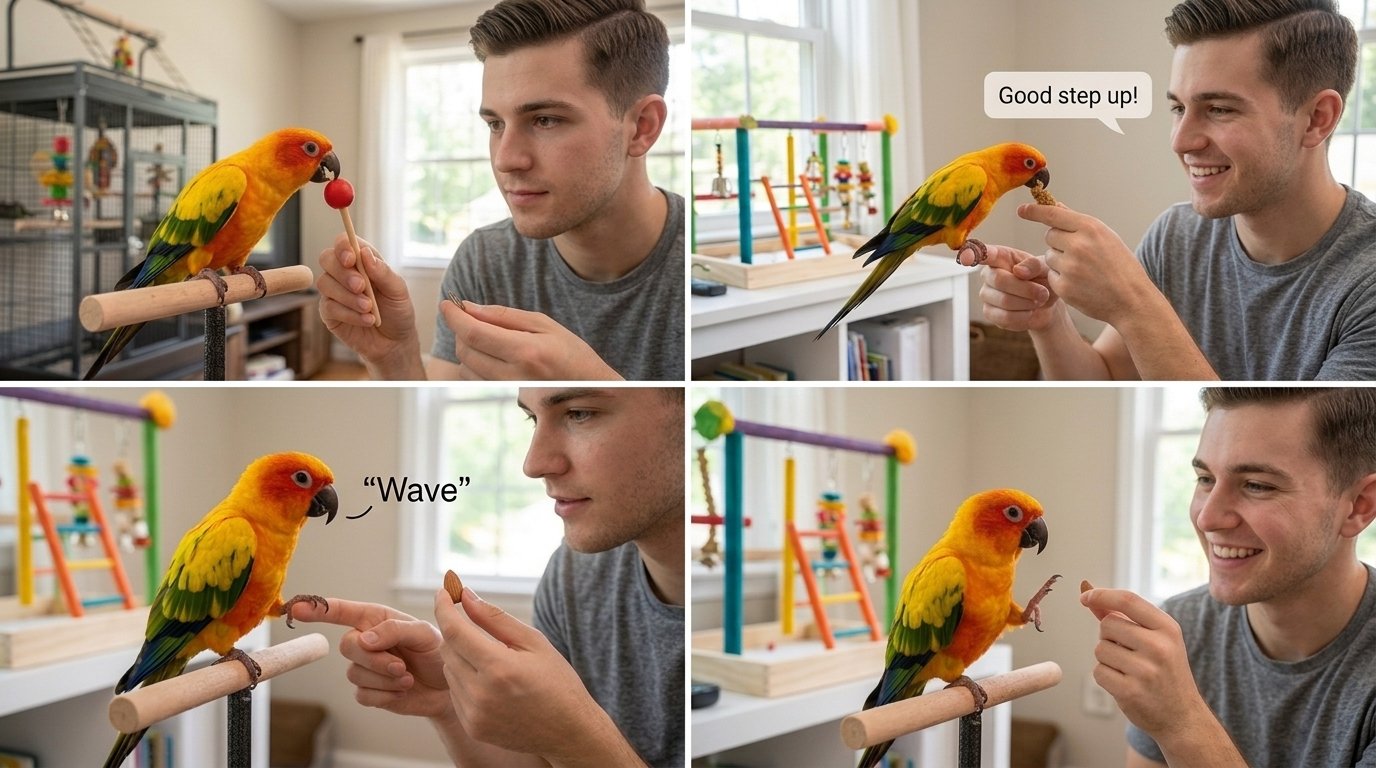
Have you ever watched a parrot wave, spin in circles, dunk a tiny basketball, or even sort objects by color and wondered how those amazing birds learned such impressive skills? The secret isn’t magic or extraordinary intelligence alone—it’s a combination of trust, consistency, positive reinforcement, and patience. Nearly every healthy pet parrot, from a playful budgie to an intelligent African Grey or energetic cockatiel, has the ability to learn tricks when training is approached correctly.
Teaching your bird tricks is about much more than entertainment. Training sessions provide valuable mental stimulation, strengthen the relationship between you and your feathered companion, and encourage healthy physical activity. Since parrots are naturally curious and highly intelligent, they actually enjoy solving problems and discovering new behaviors that earn rewards. Instead of seeing training as work, think of it as a fun conversation between you and your bird where each success builds confidence on both sides. Whether you are welcoming your very first parrot into your home or hoping to expand the skills of an experienced companion, this guide will walk you through everything you need to know, from building trust to mastering advanced tricks.
Why Teaching Tricks Benefits Every Parrot
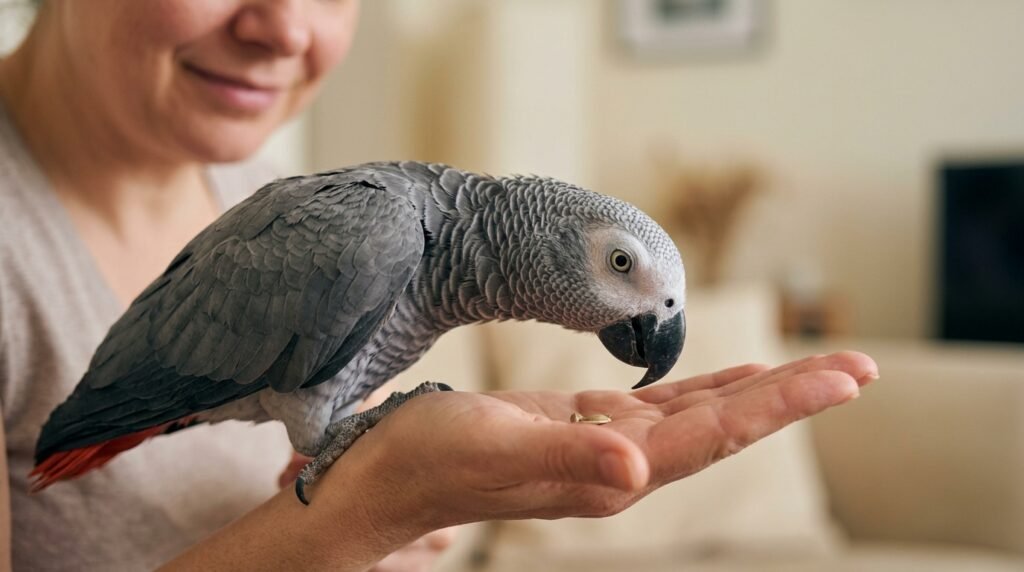
Many new bird owners assume trick training is simply a fun hobby. In reality, it plays a significant role in maintaining both the physical and emotional well-being of parrots. Wild parrots spend much of their day flying, foraging, solving problems, communicating with flock members, and avoiding predators. Life inside a home is much safer, but it can also become predictable and mentally unstimulating if enrichment opportunities are limited. Trick training recreates many of the challenges parrots naturally enjoy, giving them a healthy outlet for their remarkable intelligence.
One of the greatest benefits of training is the trust it creates between bird and owner. Every successful training session reinforces the idea that good things happen when the bird interacts with you. Instead of forcing behavior through intimidation or punishment, positive reinforcement encourages cooperation. Over time, shy parrots become more confident, nervous birds become calmer, and energetic parrots channel their excitement into productive learning. The bond that develops through daily training often carries over into everyday handling, making grooming, veterinary visits, and social interactions much easier.
Training also reduces unwanted behaviors before they become serious problems. Bored parrots frequently develop habits such as excessive screaming, feather plucking, biting, or destructive chewing. By replacing idle time with engaging activities, owners provide healthy mental exercise that keeps birds occupied. Even five to ten minutes of focused training each day can dramatically improve a bird’s overall quality of life. Think of training as exercise for the brain—it keeps your parrot mentally fit while strengthening your relationship at the same time.
Understanding How Parrots Learn
Parrots are among the world’s most intelligent birds, capable of recognizing patterns, solving puzzles, and remembering learned behaviors for years. Unlike dogs, parrots rarely respond well to dominance-based training. Instead, they thrive when they discover that performing a specific behavior consistently results in something they enjoy. Understanding this learning process is the foundation of successful trick training.
Scientists describe this process as positive reinforcement, where a desired behavior is immediately rewarded. Imagine asking your parrot to touch the end of a target stick. The instant the bird makes contact, you reward it with a favorite treat and enthusiastic praise. The parrot quickly connects the action with the reward and becomes more likely to repeat it. This simple principle can eventually teach surprisingly complex tricks by breaking larger behaviors into small, manageable steps.
Consistency is equally important. If one family member rewards a behavior while another ignores it, the bird receives confusing signals. Successful trainers always use the same verbal cue, reward the correct behavior immediately, and keep sessions short enough to prevent frustration. Since parrots have individual personalities, some may learn a new behavior within minutes, while others require several days or weeks. Progress should never be rushed. Every small improvement deserves recognition because confidence grows one successful repetition at a time.
Positive Reinforcement Explained
Positive reinforcement works because parrots naturally repeat behaviors that produce pleasant outcomes. Instead of focusing on mistakes, training emphasizes rewarding success. This creates an enjoyable learning environment where birds actively participate instead of fearing failure. Punishment, yelling, or physical corrections can damage trust and often lead to increased anxiety or aggression, making future training far more difficult.
Timing plays an enormous role in reinforcement. Rewards should be delivered within one or two seconds of the correct action so the bird clearly understands what earned the treat. Many experienced trainers use a clicker or a short marker word such as “Good!” immediately before giving the reward. This marker acts like a snapshot, telling the parrot exactly which behavior was correct. Over time, the bird begins responding faster because the connection between action and reward becomes crystal clear.
The size of the reward matters too. Tiny treats work better than large ones because they allow multiple repetitions without overfeeding. Sunflower seeds, millet pieces, almonds, walnuts, or favorite fruits often make excellent rewards depending on the species and dietary recommendations. The goal is to keep the bird excited for the next opportunity rather than full after only a few successful attempts.
Choosing the Right Rewards
Every parrot has unique preferences, making reward selection surprisingly personal. Some birds become highly motivated by sunflower seeds, while others prefer tiny pieces of walnut, pistachio, grapes, blueberries, or even enthusiastic verbal praise. The best trainers spend time discovering which treats their bird values most and reserve those special rewards exclusively for training sessions. When the reward feels special, motivation naturally increases.
Food rewards are generally the easiest option because they provide immediate satisfaction. However, affection, head scratches, favorite toys, or opportunities to play can also reinforce good behavior for particularly social parrots. Rotating rewards keeps sessions exciting and prevents boredom. Just as humans appreciate variety, parrots remain more engaged when they never know exactly which favorite treat they might earn next.
Healthy nutrition should always remain the priority. Treats should represent only a small portion of the bird’s overall diet and never replace balanced meals. Tiny rewards given frequently are far more effective than large treats offered occasionally. By combining nutritious food with enthusiastic encouragement, training becomes something your parrot eagerly anticipates every day.
Preparing for Training Success
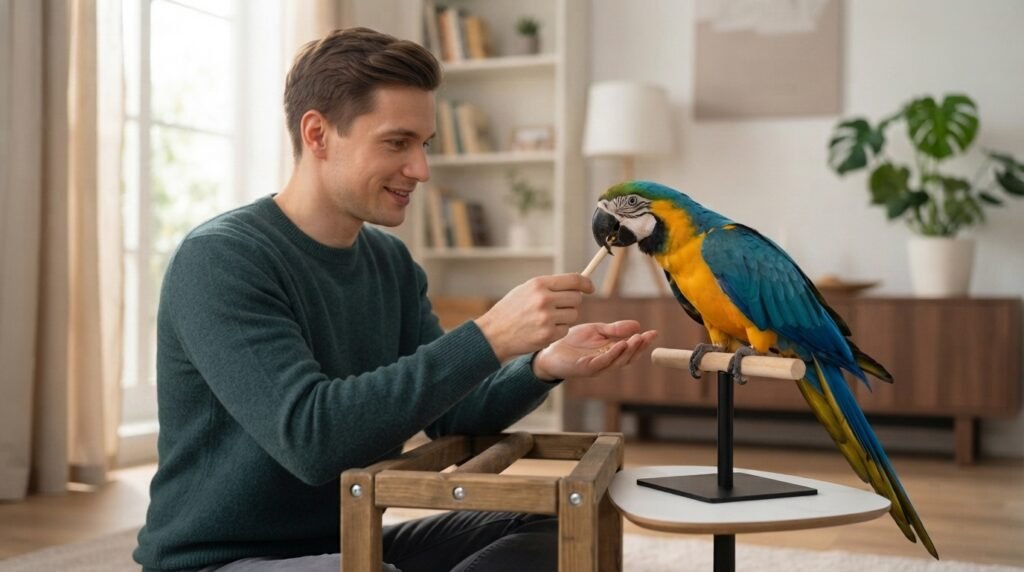
A successful training program begins long before teaching the first trick. Creating the right environment significantly increases the chances of quick learning and enjoyable sessions. One of the most common mistakes beginners make is attempting to train in busy areas filled with distractions. Televisions, loud conversations, barking dogs, or other pets can easily pull a parrot’s attention away from the lesson. Starting in a quiet, familiar room helps the bird remain focused and relaxed.
The timing of each session matters just as much as the location. Most parrots respond best when they are alert, comfortable, and slightly interested in treats without being hungry. Training immediately after a large meal often reduces motivation, while attempting lessons when the bird is tired or stressed usually leads to frustration. Short sessions lasting five to ten minutes maintain enthusiasm and prevent mental fatigue. It’s better to complete three successful five-minute sessions throughout the day than one exhausting thirty-minute lesson.
Equally important is your own attitude. Parrots are exceptionally observant and often mirror the emotions of their owners. If you become impatient or frustrated, your bird is likely to sense the tension and lose confidence. Every session should end on a positive note, even if progress seems small. Celebrate tiny victories because they create the foundation for more advanced tricks later. Like building a house brick by brick, every successful repetition strengthens your parrot’s understanding and trust.
Essential Training Supplies
One of the biggest misconceptions about parrot training is that you need expensive equipment or a professional setup. In reality, the most effective training tools are surprisingly simple and affordable. What matters far more than fancy accessories is consistency and using the right equipment at the right time. Having your supplies ready before each session allows you to focus entirely on communicating with your bird instead of searching for treats or rearranging your training area halfway through a lesson.
A clicker is among the most valuable tools for teaching tricks. It produces a short, distinct sound that marks the exact moment your parrot performs the correct behavior. If you don’t have a clicker, a short marker word such as “Good!” or “Yes!” spoken in the same tone every time works almost as well. Along with the marker, keep a pouch filled with tiny training treats that your bird absolutely loves. Since parrots often perform dozens of repetitions during a session, treats should be no larger than a pea-sized piece. This allows plenty of rewards without overfeeding your feathered student.
Another essential item is a target stick, which can be as simple as a wooden chopstick, a bamboo skewer with the sharp tip removed, or a commercially made target trainer. The target stick helps guide your parrot without physically touching it, making new tricks much easier to teach. A small training perch or tabletop stand is equally helpful because it gives your bird a dedicated place to work. When parrots recognize a specific location as “training time,” they often become focused the moment they step onto the perch.
Organization also contributes to success. Keep all supplies together in one small container so every training session begins smoothly. Some owners even maintain a simple notebook to record which tricks have been mastered and which require more practice. Tracking progress may seem unnecessary at first, but over weeks and months it becomes a useful reminder of how far your bird has come. Every tiny improvement deserves recognition because trick training is built on hundreds of small successes rather than a single breakthrough.
Creating a Distraction-Free Environment
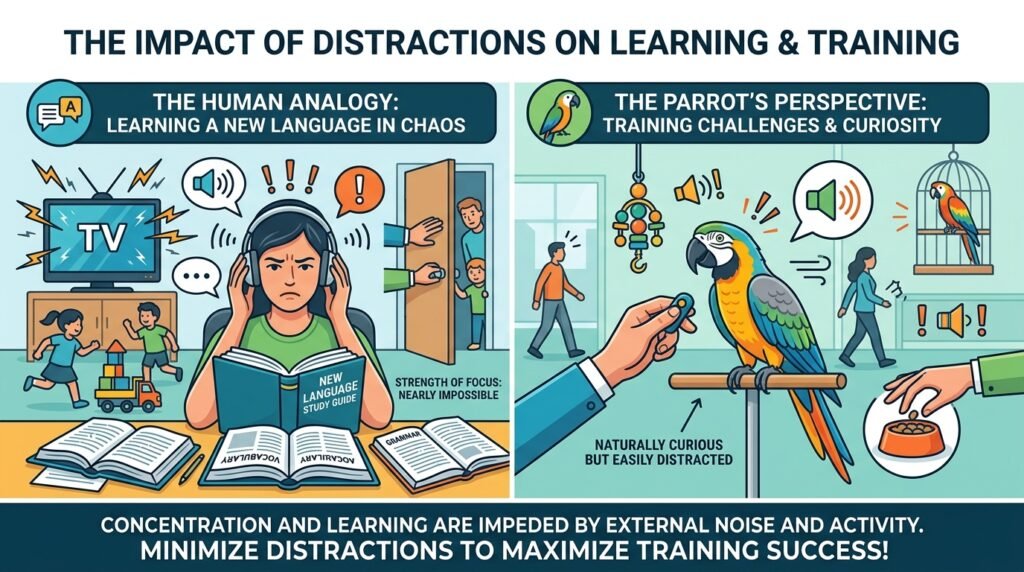
Imagine trying to learn a new language while a television blares, children are playing nearby, and someone keeps opening the door every few minutes. Concentration would be nearly impossible. Your parrot experiences similar challenges when the environment is filled with distractions. Although parrots are naturally curious, that curiosity can quickly shift their attention away from training if something more exciting appears nearby.
Choose a quiet room where interruptions are minimal. Turn off televisions, silence loud music, and keep other pets away during lessons. If your household is busy throughout the day, schedule training during naturally peaceful periods such as early morning or early evening. Many parrots are especially attentive shortly after waking up because they are well rested and eager to interact.
Lighting also influences behavior more than many owners realize. A brightly lit room helps parrots stay alert and confident, while dim lighting may encourage relaxation rather than active participation. The training perch should be positioned at a comfortable height so neither you nor your bird feels intimidated. Standing directly over a parrot can sometimes appear threatening, whereas interacting at eye level often encourages confidence and trust.
Consistency transforms an ordinary room into a familiar classroom. Using the same location every day creates predictable routines, and parrots thrive on routine. Eventually, your bird may become excited the moment it recognizes the training area because it associates that space with rewards, praise, and enjoyable interaction. Like athletes entering a stadium or musicians stepping onto a stage, parrots often perform best in environments where they know exactly what is expected.
Building Trust Before Teaching Tricks
Before asking your parrot to spin, wave, or fetch objects, you must first earn something far more valuable than obedience—its trust. Parrots are prey animals by nature, meaning they instinctively remain cautious around unfamiliar situations. Even birds that appear confident need reassurance that interacting with you is always safe and rewarding. Without trust, every trick becomes significantly harder to teach because fear competes with curiosity.
Building trust begins with respecting your bird’s comfort zone. Instead of forcing interaction, allow your parrot to approach you voluntarily. Speak softly, move slowly, and avoid sudden gestures that might trigger alarm. Spend time simply sitting near the cage, reading aloud, or talking calmly so your bird learns that your presence consistently predicts positive experiences. Many owners underestimate how powerful these quiet moments can be. Trust is rarely built during dramatic events; it develops through hundreds of calm, predictable interactions.
Offering treats through the cage bars is often an excellent first step. Once your parrot eagerly accepts treats, begin offering them from your open hand. Eventually, encourage the bird to step onto your hand voluntarily rather than reaching in to grab it. Every successful interaction teaches your parrot that choosing to engage with you leads to pleasant outcomes. This voluntary participation becomes the cornerstone of all future training.
Patience cannot be overstated. Some parrots build confidence within days, while rescued birds or naturally timid species may require weeks or even months before they fully relax. Rushing the process often delays progress rather than accelerating it. Think of trust as constructing a bridge across a river—every positive interaction adds another sturdy plank. Once that bridge is complete, communication flows naturally, making every new trick easier to learn and far more enjoyable for both of you.
Step Up
The Step Up command is widely considered the single most important behavior every pet parrot should master. Although many owners don’t think of it as a trick, experienced trainers recognize it as the foundation upon which nearly every advanced behavior is built. A bird that confidently steps onto your hand or a perch becomes easier to handle, safer during emergencies, and much more receptive to learning additional tricks.
Begin by presenting your hand or a handheld perch slightly above your bird’s feet while calmly saying, “Step Up.” Gently press against the lower chest—not forcefully, but just enough to encourage the bird to shift its balance forward. Most parrots instinctively lift one foot to regain stability, providing the perfect opportunity to step onto your hand. The instant both feet are securely positioned, mark the behavior with your clicker or marker word and immediately offer a favorite treat.
Practice in very short sessions, repeating the exercise several times before ending on a successful repetition. If your bird hesitates, never chase or force the movement. Instead, lower your expectations, reward even small attempts, and gradually build confidence over several sessions. Every positive experience strengthens the association between stepping up and receiving rewards.
Once your parrot consistently responds indoors, begin practicing in different rooms and with various perches. This process, known as generalization, teaches the bird that the command means the same thing regardless of location. Eventually, your parrot should willingly step onto your hand whenever asked, making everyday handling remarkably simple. Whether moving between rooms, visiting the veterinarian, or introducing new tricks, Step Up becomes an invaluable communication tool that enhances both safety and trust.
Target Training
If Step Up forms the foundation of handling, Target Training forms the foundation of trick training. It teaches your parrot to touch the end of a target stick with its beak, creating a simple behavior that can later guide the bird through increasingly complex movements. Many professional animal trainers—from bird specialists to marine mammal experts—use target training because it communicates clearly without physical pressure.
Start by holding the target stick a few inches from your bird’s beak. Naturally curious parrots often lean forward to investigate. The instant the beak touches the tip, click or say “Good!” and reward immediately. Don’t move the stick toward the bird; instead, allow the bird to choose the interaction. This voluntary participation builds confidence while encouraging active problem-solving.
After several successful repetitions, gradually increase the difficulty by positioning the target slightly farther away. Soon your parrot will need to take one or two steps to touch it. Continue rewarding every success until following the target becomes automatic. From there, you can guide your bird onto different perches, around obstacles, onto scales for weighing, into travel carriers, or through obstacle courses—all without grabbing or forcing movement.
Target training is remarkably versatile because it transforms a simple beak touch into a universal language between trainer and bird. Nearly every advanced trick—spinning, waving, retrieving objects, ringing bells, or even flying to specific locations—can be introduced using the target stick. Rather than teaching isolated tricks, you’re teaching your parrot how to learn, a skill that dramatically accelerates future training.
Wave Hello
One of the most charming tricks any parrot can learn is Wave Hello. Visitors instantly smile when a bird raises one foot as if greeting them, and the trick is surprisingly simple once your parrot has mastered balance and target training. Beyond entertainment, waving improves coordination, body awareness, and confidence because it requires the bird to balance comfortably on one foot.
Begin when your parrot is standing securely on a perch. Present your target stick slightly above one foot so the bird naturally lifts it while reaching toward the target. The moment the foot leaves the perch—even briefly—mark the behavior and reward generously. At first, you’re rewarding any foot movement at all. Precision comes later through repetition.
As your bird begins lifting the foot consistently, introduce the verbal cue “Wave.” Continue rewarding only the behaviors that most closely resemble a wave. Gradually increase your expectations by rewarding higher lifts or gentle back-and-forth movements. Shaping behavior through tiny improvements allows your parrot to discover the desired action without becoming confused or frustrated.
Practice with enthusiasm but keep sessions short. Before long, your parrot will associate the cue with raising its foot even when the target stick is removed. Many birds eventually perform the wave proudly whenever they see familiar people entering the room. Like a confident performer taking a bow after a successful show, your parrot will learn that greeting people brings attention, praise, and delicious rewards—making this delightful trick one of the most enjoyable milestones in your training journey.
Spin Around
One of the easiest and most entertaining tricks to teach after your parrot has mastered target training is Spin Around. This trick builds coordination, responsiveness, and confidence while reinforcing your bird’s ability to follow visual and verbal cues. Because the movement is natural and enjoyable, many parrots learn it quickly, making it an excellent confidence booster for both beginner trainers and their feathered companions.
Start by holding the target stick slightly in front of your parrot’s beak. Slowly move the stick in a circular motion around the bird’s body. Your parrot should naturally follow the target with its head and eventually take small steps until it completes a full circle. The instant the circle is complete, use your clicker or marker word such as “Good!” and immediately reward your bird with a favorite treat. Repeat this process several times without rushing. During the early sessions, your goal isn’t speed but accuracy and confidence.
As your parrot becomes comfortable following the target, begin introducing the verbal cue “Spin” just before moving the target stick. After multiple successful repetitions, gradually reduce your reliance on the target by making the guiding motion smaller each time. Eventually, many parrots will respond to the verbal command or a simple circular hand gesture alone. This gradual removal of physical guidance is known as fading the prompt, an important training technique that encourages independent responses.
Consistency remains the secret ingredient. Practice for only five to ten minutes each day, ending every session while your bird is still enthusiastic. Over time, your parrot will spin smoothly with excitement, often anticipating the reward before the trick is complete. Once mastered, Spin Around becomes an ideal transition into more advanced behaviors because it teaches your bird to respond confidently to cues while moving its entire body in a coordinated way.
Fetch Small Objects
Teaching a parrot to retrieve small objects combines several previously learned skills into one engaging behavior. This trick strengthens memory, coordination, and problem-solving while encouraging your bird to interact with its environment in creative ways. Watching a parrot pick up a small toy and place it into your hand feels remarkably similar to playing fetch with a dog, but the learning process relies entirely on positive reinforcement rather than instinct.
Choose a lightweight object that is easy for your bird to grasp, such as a wooden bead, a small plastic ring, or a miniature ball specifically designed for birds. Begin by rewarding your parrot simply for touching the object. Once that becomes reliable, reward only when your bird picks it up with its beak. The next step is rewarding the bird for holding the object for an extra second or two before releasing it. These tiny improvements may seem insignificant individually, but together they gradually build the complete behavior.
After your parrot confidently holds the object, present your open hand directly beneath its beak. Most birds naturally drop the item while adjusting their grip or reaching for a treat. The instant the object lands in your hand, mark the behavior and reward generously. Repeat this process until dropping the object into your hand becomes intentional rather than accidental. Eventually, move the object a short distance away so your bird must walk over, pick it up, and return it before earning the reward.
Patience is especially important during retrieval training because parrots often invent creative variations of the behavior. Some birds proudly carry the object around before returning it, while others enjoy tossing it onto the floor just to watch your reaction. Instead of becoming frustrated, remember that curiosity is part of your bird’s intelligence. Reward only the behaviors that move closer to your final goal, and your parrot will gradually understand exactly what earns the prize.
Ring Toss
The Ring Toss trick demonstrates just how capable parrots are at solving multi-step challenges. Beyond its entertainment value, it develops excellent beak coordination, precision, and concentration. Birds that master this exercise learn to carry an object carefully, aim accurately, and complete a sequence of actions before receiving a reward. This kind of structured problem-solving provides valuable mental stimulation that helps reduce boredom and encourages lifelong learning.
Begin by introducing a lightweight plastic ring and allowing your bird to explore it freely. Reward curiosity first, then reward picking the ring up. Once your parrot confidently carries the ring, place a short dowel or peg directly in front of the bird. Hold the ring close to the peg so the correct movement becomes obvious. Even if the ring accidentally slides onto the peg during early attempts, immediately mark the behavior and reward enthusiastically. Early success builds confidence, even when it happens by chance.
As your bird becomes familiar with the objective, gradually increase the distance between the ring and the peg. Your parrot will begin recognizing that placing the ring over the peg consistently leads to rewards. At this stage, introduce the verbal cue “Ring” or “Toss” before presenting the materials. With repetition, your bird will begin responding to the command instead of relying solely on visual guidance.
Advanced birds often learn to complete multiple ring tosses using different colored rings or varying peg locations. These added challenges encourage flexible thinking rather than simple memorization. Watching a parrot carefully align a ring before dropping it perfectly into place highlights the remarkable intelligence these birds possess. The trick becomes more than a game—it becomes an opportunity for your parrot to exercise its natural curiosity and problem-solving abilities every single day.
Basketball
Few tricks impress friends and family more than a parrot confidently scoring a basket. Miniature bird basketball sets have become increasingly popular because they combine movement, coordination, and target training into one exciting activity. Fortunately, you don’t need an expensive commercial toy. A small plastic ball and a tiny hoop or cup are enough to begin teaching this crowd-pleasing skill.
Start by rewarding your parrot for touching and picking up the ball. Once carrying the ball becomes reliable, position the hoop immediately beneath your bird’s beak. Most parrots naturally release the ball while reaching for their reward, allowing it to fall into the basket. The moment this happens, click and provide enthusiastic praise along with a favorite treat. After several successful repetitions, gradually move the hoop farther away so your bird must walk toward it before releasing the ball.
As confidence grows, introduce the verbal cue “Basket!” before presenting the ball. Continue increasing the distance little by little, allowing your bird to think through each challenge independently. Some parrots eventually learn to carry the ball across an entire table before making the shot. Others become so enthusiastic that they eagerly search for the ball the moment they see the basketball hoop appear.
Basketball training demonstrates the power of combining previously learned skills. Target training, object retrieval, balance, and confidence all contribute to success. More importantly, the game provides excellent exercise while strengthening your relationship with your parrot. Every successful basket becomes another shared achievement, reinforcing the idea that learning new challenges is both fun and rewarding.
Advanced Tricks for Intelligent Parrots
After mastering foundational behaviors, many parrots are ready for challenges that require genuine cognitive problem-solving rather than simple physical movements. Advanced tricks stimulate memory, reasoning, and discrimination skills, giving highly intelligent species such as African Greys, Amazons, Eclectus parrots, Macaws, and Cockatoos opportunities to demonstrate their impressive mental abilities. While these exercises require more patience, they often become the most rewarding part of long-term training.
Advanced training should always progress gradually. Complex behaviors are never taught in a single session but instead broken into dozens of small, achievable steps. Each success builds on previous lessons, creating a clear path toward increasingly sophisticated skills. This structured approach prevents frustration while maintaining your bird’s enthusiasm for learning.
Remember that every parrot develops at its own pace. Some individuals eagerly embrace new puzzles, while others prefer repeating familiar tricks. Neither personality is better than the other. Your goal is to encourage learning while respecting your bird’s natural preferences and comfort level.
Color Recognition
Color recognition is one of the most fascinating demonstrations of parrot intelligence because it shows that birds can learn to distinguish visual categories rather than simply memorizing movements. Begin with two brightly colored objects, such as a red block and a blue block. Reward your parrot only for touching or selecting the red object while ignoring the blue one. Repeat this process consistently until the correct choice becomes reliable.
Once your bird consistently identifies the correct color, introduce a verbal cue such as “Red.” Continue rewarding only accurate selections while gradually adding additional colors. Over time, many parrots learn to distinguish several colors with remarkable accuracy. This ability not only impresses observers but also provides valuable mental enrichment through visual discrimination and memory.
Training should remain playful rather than demanding. If your parrot appears confused, simplify the exercise by reducing the number of choices or increasing the visual contrast between objects. Small successes build momentum, eventually allowing your bird to make increasingly accurate selections with confidence.
Shape Matching
Shape matching represents another exciting cognitive challenge that encourages logical thinking. Start with two simple shapes, such as a circle and a square, along with matching containers or outlines. Reward your parrot whenever it places the correct shape into its corresponding location. At first, guidance from a target stick may help direct the movement, but gradually reduce assistance as understanding improves.
This activity strengthens observation skills, memory, and precision while encouraging your bird to analyze differences between objects before making a choice. Some parrots eventually learn to match several different shapes, creating an engaging enrichment activity that can be repeated throughout their lives.
More importantly, shape matching demonstrates that training extends far beyond entertainment. It provides meaningful mental exercise that mirrors the problem-solving challenges wild parrots encounter while foraging and interacting with their environment. By encouraging thoughtful decision-making, these advanced exercises help keep intelligent companion birds mentally active, emotionally satisfied, and eager to continue learning.
Common Training Mistakes to Avoid
Even the most enthusiastic bird owners occasionally make mistakes during training. The good news is that parrots are remarkably forgiving when training remains positive and consistent. Recognizing common pitfalls early helps you build a stronger relationship with your bird while making every lesson more productive. Like learning any new skill, becoming a better trainer often means refining your own habits as much as teaching your parrot new behaviors.
One of the most frequent mistakes is making training sessions too long. Parrots are intelligent, but their attention spans are limited. A lesson that lasts five to ten minutes usually produces far better results than a session stretching beyond twenty minutes. As your bird begins to lose focus, it may start grooming, looking around the room, or playing with nearby objects instead of responding to cues. Rather than pushing through these signs, end the lesson after a successful repetition. Finishing on a positive note keeps your parrot eager for the next session instead of viewing training as tiring or stressful.
Another common error is inconsistent rewards. If a trick earns a treat one day but is ignored the next, your bird receives mixed messages. Consistency helps parrots understand exactly which behaviors lead to positive outcomes. Equally important is timing. Rewards should arrive immediately after the desired action. Even a delay of a few seconds can cause confusion because your bird may associate the reward with an entirely different behavior. Using a clicker or a consistent marker word greatly improves communication by identifying the precise moment the correct behavior occurred.
Many owners also expect progress to happen too quickly. Every parrot learns at its own pace, influenced by age, personality, species, previous experiences, and motivation. Comparing your bird to videos on social media often creates unrealistic expectations. Those impressive performances usually represent months or years of dedicated practice rather than overnight success. Celebrate every small improvement, whether it’s taking one extra step toward a target stick or lifting a foot slightly higher during a wave. These tiny victories accumulate into remarkable achievements over time.
Finally, avoid punishment. Yelling, tapping the beak, forcing a bird into position, or showing frustration damages trust and reduces confidence. Positive reinforcement remains the safest, most humane, and most effective method for teaching parrots. When mistakes happen, simply reset the exercise, simplify the task if necessary, and reward the next successful attempt. A patient trainer creates a confident learner, and confidence is the foundation of every impressive trick your parrot will eventually master.
Conclusion
Training your parrot is about much more than creating entertaining performances. Every trick represents another layer of communication between you and your feathered companion. From the first successful Step Up command to advanced activities like color recognition and basketball, each lesson strengthens trust, encourages curiosity, and provides valuable mental stimulation. What begins as a simple training session often develops into one of the most rewarding parts of parrot ownership.
Consistency is the greatest predictor of success. Daily sessions lasting only a few minutes can accomplish far more than occasional marathon lessons. By keeping training enjoyable, rewarding, and free from punishment, you create an environment where learning becomes something your parrot genuinely anticipates. Positive reinforcement transforms every interaction into an opportunity for growth, helping your bird associate you with safety, encouragement, and exciting challenges.
Remember that every parrot is unique. Some birds race through new tricks, while others prefer mastering one skill before moving to the next. Neither approach is right or wrong. Respect your bird’s individual personality, celebrate gradual improvement, and remain patient throughout the journey. Progress should always be measured against your bird’s previous achievements rather than someone else’s.
The greatest reward isn’t teaching your parrot to wave, spin, retrieve objects, or score miniature basketball baskets. It’s watching a once-hesitant bird eagerly approach each training session with confidence, curiosity, and excitement. Those moments reveal the true purpose of trick training—a stronger bond built on trust, mutual understanding, and shared experiences that enrich both your life and your parrot’s for many years to come.
Frequently Asked Questions (FAQs)
1. How long does it take to teach a parrot its first trick?
Most parrots can learn a simple behavior such as Step Up or touching a target stick within a few days to a couple of weeks when trained consistently. Intelligent, highly motivated birds may progress even faster, while shy or rescued parrots often need additional time to build confidence. Daily five-to-ten-minute sessions generally produce the best results.
2. What are the best treats for parrot training?
The ideal training treat is small, healthy, and highly motivating. Tiny pieces of almonds, walnuts, sunflower seeds (in moderation), millet, blueberries, grapes, or species-appropriate fruit often work well. Reserve your bird’s favorite treats exclusively for training to keep motivation high.
3. Can older parrots still learn new tricks?
Absolutely. The saying “You can’t teach an old dog new tricks” certainly doesn’t apply to parrots. Healthy adult and senior parrots remain capable of learning throughout their lives. Older birds may progress more slowly than younger ones, but patience, consistency, and positive reinforcement are just as effective.
4. How often should I train my parrot?
Aim for one to three short sessions each day, lasting around five to ten minutes each. Frequent, enjoyable practice is far more effective than occasional lengthy sessions. Always end while your parrot is still engaged and motivated.
5. What should I do if my parrot refuses to train?
If your parrot seems uninterested, first rule out common issues such as fatigue, illness, stress, or environmental distractions. Try using higher-value treats, shortening the session, or returning to an easier behavior your bird already knows. Never force participation. Building trust and keeping training enjoyable will naturally increase enthusiasm over time.
 ADMIN ADMIN