Witch Croc: The Two-Legged Crocodile That Looked Like a Dinosaur
Witch Croc: The Two-Legged Crocodile That Looked Like a Dinosaur
Meet the “Witch Croc”: The Bizarre Two-LeggedCrocodile Relative That Looked Like an Ostrich Dinosaur
212 million years ago, a beaked, toothless, two-legged reptile stalked the ancient landscape of what is now New Mexico. It belonged to the crocodile lineage. It looked exactly like a dinosaur. It has just been given a name: Labrujasuchus expectatus — the “Witch Croc.” And it is one of the most bizarre animal discoveries of 2026.
📝 In this article
- The wild Triassic world this creature inhabited
- What was Labrujasuchus expectatus?
- Where and how it was found: 20 years at Ghost Ranch
- Anatomy of the Witch Croc: beaked, bipedal, and toothless
- Convergent evolution: when nature reinvents the same design
- Why is a bipedal, beaked animal in the crocodile family?
- Filling the evolutionary gap: what it means for the shuvosaur family
- The Triassic: the strangest era in animal history
- Why discoveries like this still matter
Close your eyes and picture a crocodile. Almost certainly, you are imagining something low and heavy: four thick legs splayed to the sides, a long jaw full of teeth, rough armored skin dragging along a riverbank. A cold, patient, ancient predator built close to the ground and comfortable in water.
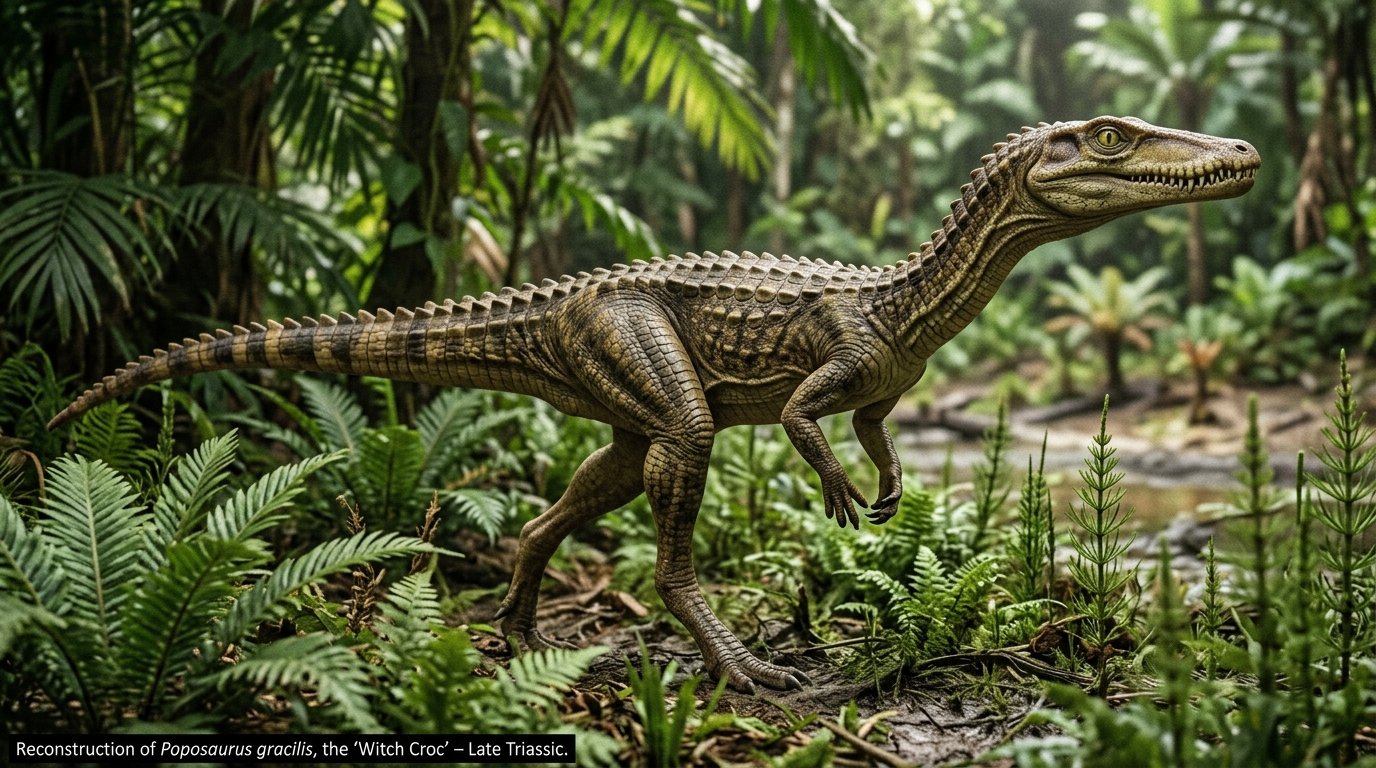
Now imagine the exact opposite of that animal. Tall and upright. Walking on two long hind legs. A beak where the teeth should be. Tiny, almost vestigial forelimbs. Moving through a prehistoric forest more like a modern cassowary than anything we associate with crocodiles.
That is Labrujasuchus expectatus. It is a crocodile relative. It lived 212 million years ago. It looked nothing like a crocodile. And its discovery, published in the Journal of Vertebrate Paleontology in May 2026, is throwing new light on one of the most bizarre and underappreciated periods in the history of animal life on earth.
What exactly was Labrujasuchus expectatus?
Labrujasuchus expectatus was a shuvosaurid — a member of a small and deeply strange group of ancient reptiles from the Triassic Period. The shuvosaurs belong to the archosaur lineage that led to modern crocodiles, not the lineage that led to dinosaurs and birds. But somewhere in the early Triassic, the shuvosaur branch of the crocodile lineage took a dramatic evolutionary detour and developed a body plan that looks, to any untrained observer, indistinguishable from a bipedal theropod dinosaur.
The result — this beaked, toothless, two-legged animal — is a perfect example of what biologists call convergent evolution: the independent development of similar traits in unrelated lineages. The shuvosaurs and the bipedal dinosaurs arrived at a similar body plan from completely different evolutionary starting points, driven by the similar pressures and opportunities of their shared environment.
Where and how it was found: 20 years of digging at Ghost Ranch
Ghost Ranch is a name with weight in American paleontology. Located in the high desert of northern New Mexico, the site has been producing extraordinary Triassic fossils for nearly a century. It was here that massive bonebeds of Coelophysis — one of the earliest true dinosaurs — were discovered in the 1940s, changing understanding of early dinosaur biology. It was here that Georgia O’Keeffe painted the landscape for decades, drawn by the same otherworldly red-rock terrain that preserves ancient bones so well.
The Natural History Museum of Los Angeles County has been conducting systematic excavations at Ghost Ranch for 20 years. In that time, the project has yielded a steady stream of discoveries about the bizarre diversity of Triassic life. Labrujasuchus expectatus is the latest — and the most unexpected — of those finds.
The genus name Labrujasuchus combines la bruja (the witch, from the site’s old Spanish name “Ranch of the Witches”) with the Greek suchus, meaning crocodile. The species name expectatus — meaning “expected” — reflects the fact that paleontologists had long predicted a shuvosaur from this time period and location must exist. It was the expected discovery. It just took two decades of digging to find it.
Anatomy of the Witch Croc: beaked, bipedal, and utterly unlike a crocodile
The known fossil material of Labrujasuchus expectatus includes parts of the forelimb, vertebrae, hindlimbs, and pelvic region. From these elements, researchers can reconstruct a remarkably clear picture of what this animal looked like and how it moved.
🦕 Anatomy at a glance
- Bipedal stance — walked upright on two powerful hind legs, like a large bird or theropod dinosaur
- Toothless beak — no teeth at all; the mouth ended in a beak, indicating a diet very different from the typical carnivorous crocodile lineage
- Tiny forelimbs — reduced to near-vestigial status, similar to the small arms of certain theropod dinosaurs
- Upright posture — unlike any modern crocodile, which is semi-sprawling and four-legged
- Medium body size — roughly comparable to a large ostrich, based on limb proportions
- Archosaur skeleton — the underlying bone structure identifies it clearly as belonging to the crocodile-line archosaurs, not the dinosaur line
The combination of features — particularly the bipedal stance, toothless beak, and reduced forelimbs — is what makes this animal so striking. These are characteristics we associate with ornithomimosaur dinosaurs: the ostrich-like runners of the Cretaceous period, animals like Gallimimus and Struthiomimus that looked, more than anything else, like feathered ostriches with longer arms. Labrujasuchus arrived at an eerily similar design 80 million years earlier — from the opposite side of the archosaur family tree.
Convergent evolution: when nature independently invents the same solution
The concept of convergent evolution is one of the most philosophically rich ideas in biology. It describes the repeated, independent emergence of similar traits in unrelated lineages — driven not by shared ancestry but by shared environmental pressures and opportunities.
The classic examples are familiar: dolphins and sharks have similar streamlined body shapes because swimming efficiently in water selects for that form, regardless of whether you’re a mammal or a fish. Wings evolved independently in birds, bats, and insects. Eyes have evolved independently over 40 times in different animal lineages. Each case tells us something profound: that there are a limited number of truly good solutions to the challenges of survival, and life tends to find them over and over again, regardless of starting point.
Labrujasuchus adds another data point to this pattern. Bipedalism — walking upright on two legs — freed the forelimbs for other uses and allowed animals to move quickly and efficiently in open or semi-open environments. The Triassic shuvosaurs evolved it independently of the dinosaurs that would later dominate the same landscapes. Tens of millions of years later, the ornithomimosaur dinosaurs converged on essentially the same design again.
Why is a bipedal, beaked animal in the crocodile family at all?
This is the question that stops most people when they first hear about the shuvosaurs. If this animal looks nothing like a crocodile, walks nothing like a crocodile, and has none of the distinctive features we associate with crocodiles — why is it classified in the crocodile lineage?
The answer lies in deep evolutionary relationships that are not visible in external appearance. Labrujasuchus and modern crocodiles share a common ancestor that was distinct from the common ancestor of dinosaurs and birds. This shared ancestry is reflected in features of the skeletal anatomy — particularly the structure of the ankle joint, certain features of the skull, and details of the hip socket — that identify the animal as a pseudosuchian archosaur (the crocodile-line) rather than an ornithodiran (the dinosaur-bird line).
In the Triassic, the crocodile lineage was wildly diverse. It included heavily armored predators, plant-eaters, semi-aquatic ambush hunters, and — as Labrujasuchus shows — bipedal, beaked forms that looked nothing like any crocodile that exists today. The familiar, semi-aquatic crocodile body plan that survived to the present day is just one outcome of a lineage that once experimented with an astonishing variety of forms. The “Witch Croc” is a fossil of that lost diversity.
Filling the evolutionary gap: what this means for the shuvosaur family
Only five shuvosaurid species have ever been identified, making Labrujasuchus the fifth known member of this remarkable group. Its significance extends beyond the novelty of the individual species: it fills a specific and previously frustrating gap in the shuvosaur fossil record.
Paleontologists had already identified shuvosaurs from both earlier and later Triassic deposits in the American Southwest. They knew the group existed across this time range. But there was a gap in the middle — a stratigraphic interval from which no shuvosaur had been recovered, leaving the lineage’s evolutionary history incomplete. Labrujasuchus expectatus fits precisely into that gap, providing the evolutionary link that was expected but had not been found. The species name — expectatus, “expected” — acknowledges this directly. The discovery was anticipated. It was still worth celebrating.
The Triassic: the strangest era in the history of animal life
To fully appreciate Labrujasuchus, it helps to understand the world it inhabited. The Triassic Period, stretching from approximately 252 to 201 million years ago, was the era immediately following the greatest mass extinction in earth’s history — the Permian-Triassic extinction event, which eliminated more than 90% of marine species and 70% of terrestrial species. What followed was an evolutionary free-for-all: with so many ecological niches emptied simultaneously, life diversified explosively into forms and body plans that have no direct equivalents in the modern world.
Ghost Ranch in the Late Triassic was inhabited by an almost science-fictional cast of creatures: Drepanosaurus, a tree-climbing reptile with a single large claw on each hand; Vancleavea, an aquatic armored reptile that moved like a salamander with armor plating; Coelophysis, one of the earliest true dinosaurs; and now Labrujasuchus, striding through it all on two legs with its beak held high.
The Triassic is, in many ways, the era that built the modern animal world — where the body plans and strategies that would dominate for the next 200 million years were first tried, tested, and either retained or discarded. Labrujasuchus and its shuvosaur relatives were one of evolution’s experiments that ultimately did not survive into the modern era. But for tens of millions of years, they thrived — and their story tells us that the crocodile lineage was once capable of far more than the patient riverside ambush we know today.
Why discoveries like this still matter in 2026
In a world of urgent, present-tense crises — extinction rates, habitat loss, climate change — it can feel indulgent to celebrate the discovery of a 212-million-year-old beaked reptile. But paleontology is not simply an exercise in cataloguing the past. It is one of our primary tools for understanding the principles that govern how life works: how evolution generates diversity, how body plans spread and persist and disappear, how entire lineages can rise, flourish, and vanish while leaving behind only the faintest traces in stone.
Every time a discovery like Labrujasuchus is made, it adds another data point to the grand pattern of life on earth. It shows us that the biological diversity we see today is only a fraction of what has existed. That the forms life can take are far stranger and more varied than anything we currently observe. And that the world has always been more interesting, more complex, and more surprising than our current limited view of it suggests.
Somewhere in the red rocks of Ghost Ranch, a two-legged, beaked, toothless crocodile relative waited 212 million years to be found. It was worth the wait.
🦕 More prehistoric discoveries, every day
Animal World Blog covers the latest paleontology, wildlife science, and conservation news. New stories every day — bookmark us now.