Scimitar-Horned Oryx Makes a Remarkable Comeback With Newborn Calf
Scimitar-Horned Oryx Makes a Remarkable Comeback With Newborn Calf
Once Declared Extinct in the Wild, the Scimitar-Horned Oryx Is Fighting Back — And a Newborn Calf Just Joined the Fight
In the year 2000, the scimitar-horned oryx was declared extinct in the wild. A species that once roamed the Sahara in herds of hundreds of thousands had vanished from the earth. Twenty-six years later, a newborn calf took its first shaky steps at a Louisiana wildlife park — one of hundreds of oryx that captive breeding programs and a remarkable reintroduction effort have brought back from oblivion. This is one of conservation’s most extraordinary stories.
📝 In this article
- Who is the scimitar-horned oryx?
- How a species vanished in a single century
- The captive breeding lifeline that saved them from total extinction
- The reintroduction: returning oryx to Chad
- Timeline of a comeback: 2000 to 2026
- The new calf in Louisiana: every birth matters
- The challenges that remain
- What the oryx teaches us about conservation
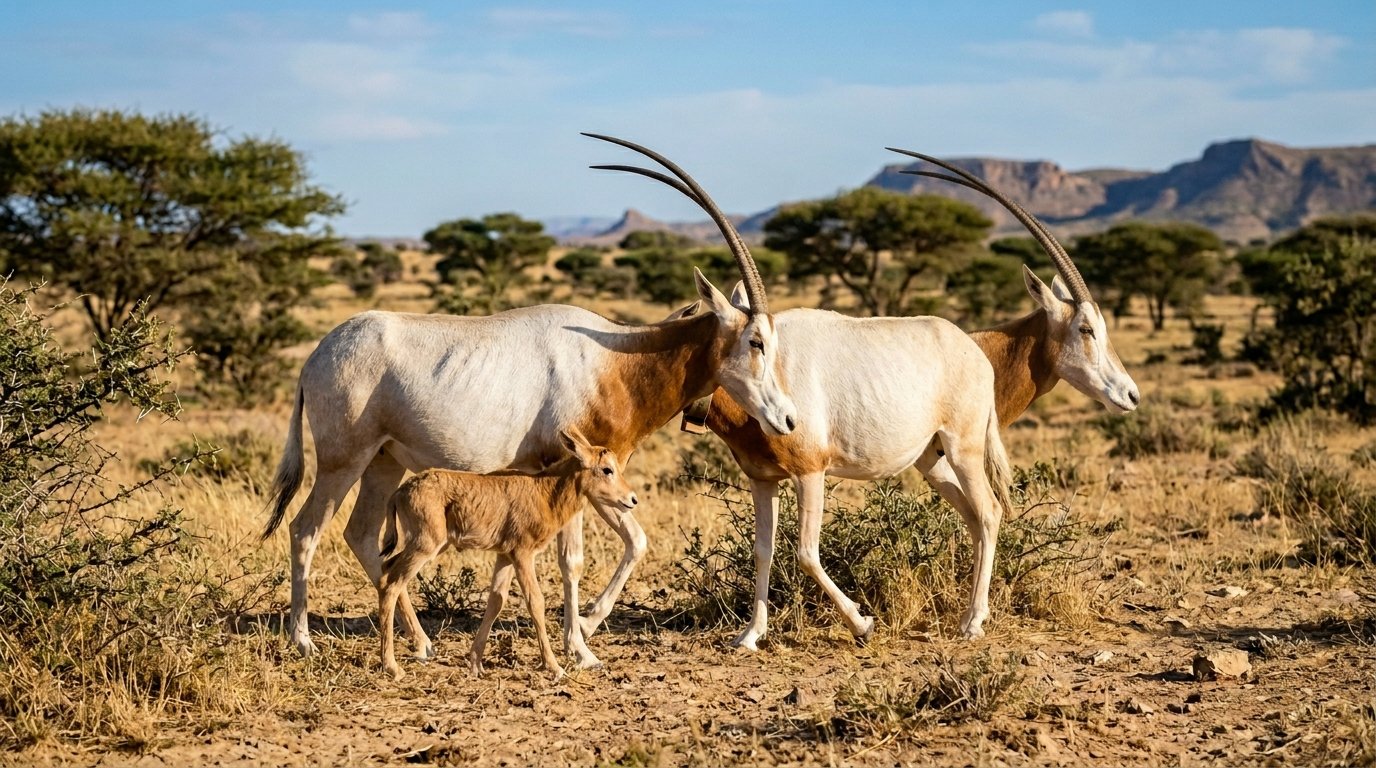
The scimitar-horned oryx (Oryx dammah) is one of Africa’s most visually striking animals. An antelope of the southern Sahara, it stands about 120 centimeters at the shoulder and carries a coat of creamy white and reddish-brown that reflects heat with remarkable efficiency — an adaptation to one of the harshest environments on earth. But its defining feature is its horns: long, sweeping, ringed curves that arc backward from the skull in a silhouette so dramatic that many historians believe this species may have inspired the ancient myth of the unicorn. When viewed from the side, the two horns overlap and appear as one.
In their prime, scimitar-horned oryx roamed across a vast sweep of northern Africa — from the Atlantic coast of Senegal and Mauritania eastward through Mali, Niger, Chad, Sudan, and into Egypt. They were built for the desert: capable of tolerating an internal body temperature of 47°C to conserve water, surviving for days without drinking, and traveling enormous distances to find the sparse rainfall that triggers the brief bursts of vegetation the Sahara produces after storms.
At the peak of their population, estimates suggest there were hundreds of thousands of these animals. Their herds shaped the ecology of the Sahara, dispersing seeds, creating pathways, and sustaining predators across a landscape most people consider simply empty.
How an entire species vanished in a single century
The scimitar-horned oryx was not always rare. As recently as the 1930s, sightings of large herds were still being reported across the Sahel. But the 20th century brought a convergence of pressures that the species could not withstand: systematic overhunting, first by colonial-era hunters and later by commercial poachers pursuing both the meat trade and the luxury market for horns; the expansion of agriculture and pastoralism into former habitat; and recurring severe droughts across the Sahel region that reduced the already sparse vegetation the oryx depended on.
By the 1980s, confirmed wild sightings had become vanishingly rare. By the 1990s, they had effectively ceased. The animals were not disappearing — they had disappeared. In 2000, the IUCN Red List made it official: the scimitar-horned oryx was extinct in the wild. One of the largest antelopes of the Sahara had been erased from its native range within a human lifetime.
What prevented total extinction was the foresight of zoos and private wildlife parks that had been building captive populations since the 1960s. When the wild population collapsed, thousands of animals were already living in managed facilities across North America, Europe, and the Middle East. It was these captive populations — maintained, bred, and carefully managed for genetic diversity — that kept the species alive through the darkest decades of its history.
The captive breeding lifeline that saved them from total extinction
The story of scimitar-horned oryx captive breeding is a testament to what coordinated international conservation can achieve over decades. Zoos across the United States, Europe, and the Middle East collaborated through Species Survival Plans — coordinated breeding programs that carefully managed which animals mated with which to maximize genetic diversity across the captive population.
The genetic management challenge was significant: the global captive population, while numbering in the thousands, traces back to a small founding group, creating potential inbreeding risk over multiple generations. Pioneering work at institutions including the Smithsonian Conservation Biology Institute developed artificial insemination techniques that allowed the exchange of genetic material between geographically separated populations without the stress and risk of transporting live animals. This innovation directly improved the genetic health of oryx populations worldwide and later became a key tool in the reintroduction program.
The reintroduction: bringing oryx back to the Sahara
In 2016, the Environment Agency of Abu Dhabi — which had built one of the world’s largest scimitar-horned oryx captive populations as part of its commitment to Saharan wildlife conservation — partnered with the Government of Chad to begin releasing captive-bred animals into the Ouadi Rime-Ouadi Achim Game Reserve in central Chad. The reserve, covering an area larger than England, encompasses prime historical oryx habitat.
The reintroduction was carefully phased. Animals were released in managed groups with veterinary monitoring. GPS collars tracked their movements. Researchers observed their behavior, diet, and social structures as they adjusted to wild conditions. Early mortality rates were higher than hoped — desert survival is genuinely difficult, and captive-raised animals lack some of the learned behaviors that wild-born animals acquire from experienced mothers and social groups.
But the oryx adapted. They bred. Their calves grew up in the wild, acquiring the knowledge and behaviors their parents had lacked. By 2021, more than 360 semi-wild oryx were present in the reserve. By the time the IUCN made its landmark 2023 announcement — upgrading the species from “extinct in the wild” to “endangered” — more than 600 new individuals had been added to the wild population since the reintroduction began.
Timeline of a comeback: 2000 to 2026
-
2000Declared extinct in the wild
IUCN officially lists scimitar-horned oryx as extinct in the wild. Thousands remain in captive facilities worldwide.
-
2016First wild reintroductions begin in Chad
The Environment Agency of Abu Dhabi and Government of Chad begin releasing captive-bred animals into Ouadi Rime-Ouadi Achim Game Reserve.
-
2021360+ semi-wild animals confirmed
The reintroduced population is breeding successfully. Wild-born calves are growing up in the Sahara for the first time in over two decades.
-
2023IUCN upgrades status to “Endangered”
A landmark moment: the species is no longer extinct in the wild. Over 600 new individuals have been added to the wild population since 2016.
-
June 2026New calf born at Global Wildlife Center, Louisiana
A fledgling scimitar-horned oryx, likely born just hours before a media tour, joins the center’s herd of 13. Every captive birth strengthens the global genetic safety net.
The new calf in Louisiana: why every single birth matters
On a morning in early June 2026, a television crew visiting the Global Wildlife Center in Folsom, Louisiana, arrived to find an unexpected addition to the park’s oryx herd. A fledgling scimitar-horned oryx, so new to the world that its legs were still unsteady, had been born just hours earlier. The calf brought the center’s total to 13 oryx.
It is easy to look at a number like 13 and think: small. Inconsequential. Not enough to matter against a backdrop of extinction and recovery. But this is precisely the wrong way to think about conservation genetics.
In a species recovering from near-total wild extinction, every individual born in captivity carries genetic material that may be irreplaceable. The global captive population is the species’ genetic safety net — the reservoir from which future reintroductions will draw. A calf born in Louisiana today may produce offspring whose descendants walk the Sahara in 2050. The chain of survival runs through every single birth, in every facility, in every corner of the world where people are willing to maintain it.
The challenges that remain
The oryx comeback is genuine and remarkable. It is also fragile and incomplete. The reintroduced Chad population, while growing, still faces serious threats: political instability in the region has made consistent monitoring and protection difficult at times; poaching pressure, though reduced, has not been eliminated; and the effects of climate change on Saharan rainfall patterns could significantly affect the vegetation that oryx depend on in ways that are difficult to predict.
The species’ IUCN status, while upgraded from “extinct in the wild,” remains “Endangered” — not “Vulnerable,” not “Near Threatened.” The upgrade is a celebration of progress, not a declaration of safety. The work of building a self-sustaining wild population, large enough and genetically diverse enough to persist without ongoing human intervention, is still decades from completion.
What the scimitar-horned oryx teaches us about conservation
The scimitar-horned oryx story is many things at once. It is a tragedy — a magnificent creature hunted and pressured to extinction in the wild within a single human lifetime. It is a testament to human foresight — the zoos and wildlife parks that maintained captive populations through the darkest decades, and the scientists who developed the assisted reproduction techniques to keep those populations genetically healthy. It is a triumph — the reintroduction of a species to its native habitat, breeding successfully in the wild for the first time in over two decades.
And it is a warning. The oryx survived because people acted before it was entirely too late. Other species — dozens, hundreds, thousands of them currently listed as critically endangered or extinct in the wild — are waiting for the same combination of resources, commitment, and coordinated action. Some of them will get it. Too many will not.
A newborn oryx calf on unsteady legs in a Louisiana park is, in its small wobbling body, carrying the weight of a species that refused to disappear. That is worth knowing. That is worth celebrating. And it is worth asking: what are we willing to do to make sure it keeps going?
🦖 More conservation stories that matter
Animal World Blog covers wildlife recoveries, extinctions, and the work being done every day to protect the animals we share this planet with. Come back tomorrow.