
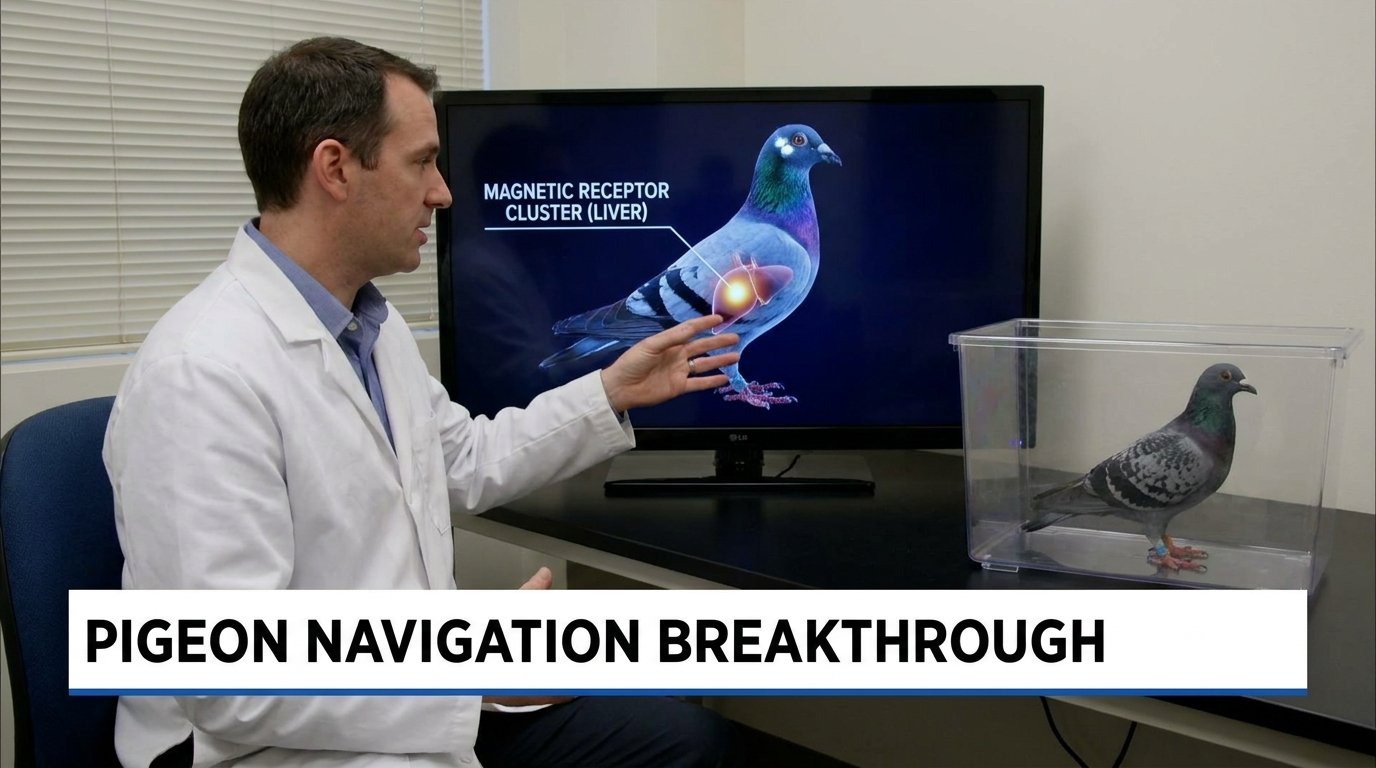
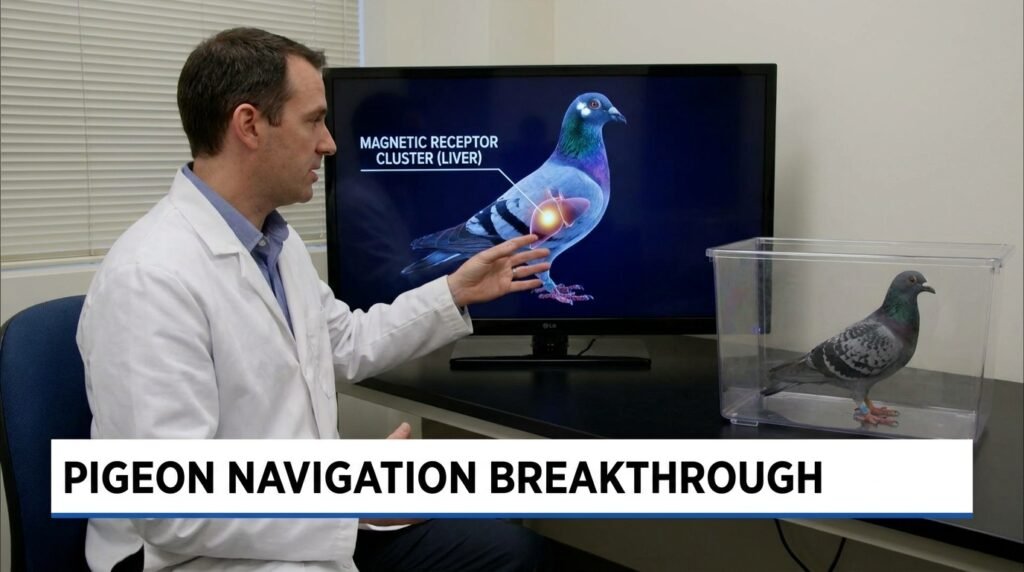
Pigeons Have a Secret GPS Hidden in Their Livers | And It Just Changed Everything We Knew About Animal Navigation
For centuries, sailors watched pigeons fly home across hundreds of kilometers and shook their heads in wonder. Scientists have studied the mystery for decades, proposing theories involving eyes, brains, beaks, and even inner ears. The answer, it turns out, was hiding somewhere nobody thought to look: the liver. A landmark study published in Science in May 2026 has finally cracked one of nature’s most enduring navigation mysteries.
📝 In this article
- The 2,000-year-old mystery of pigeon navigation
- The accidental discovery that started in a lab frustration
- How iron-filled liver cells work as a magnetic compass
- The experiment that proved it: take away the cells, lose the way home
- The quantum connection: superparamagnetism explained
- What this means for all animals — not just pigeons
- The stunning twist: immunity and navigation may be linked
- 7 pigeon facts that will make you see them completely differently
- Why the liver of a pigeon changes how we understand life on earth
Homing pigeons have been used by humans for at least 3,000 years. Ancient Egyptians used them to carry messages. Roman commanders deployed them in battle. During both World Wars, pigeon carriers saved lives by transmitting intelligence across enemy lines when all other communication had failed. A pigeon named Cher Ami delivered a message that saved 194 stranded American soldiers in 1918 despite being shot through the chest. A pigeon named G.I. Joe saved a British battalion from friendly fire in 1943.
And for all of that time — for three thousand years of human reliance on pigeon navigation — nobody knew quite how they did it. How does a bird released 500 kilometers from its home, in a location it has never visited, find its way back with reliable accuracy? How does it navigate at night, in fog, across featureless ocean? What internal instrument is it reading?
The question has consumed animal scientists for decades. Theories have multiplied. Evidence has accumulated and then been contradicted. In 2026, a research team from the Max Planck Institute of Animal Behavior in Germany, working with colleagues from the University of Bonn and multiple international institutions, published what may be the definitive answer. It was published in Science — one of the world’s most prestigious scientific journals — and it points to a place nobody expected: the liver.
The accidental discovery that started with a laboratory frustration
The story of how this discovery was made is itself a beautiful reminder of how science actually works — not through grand planned experiments, but through curiosity about unexpected observations.
Professor Christian Kurts, an immunologist at the University of Bonn, had spent years studying immune cells called macrophages. In the course of his lab work, he had repeatedly been frustrated by a strange phenomenon: macrophages from mouse spleens kept sticking to the magnetic columns used to separate different cell types in his experiments. They would not come free.
When he investigated why, he discovered that these macrophages had been accumulating iron atoms from the breakdown of old red blood cells — and that iron was aligning with magnetic fields, causing the cells to stick. The macrophages were, in effect, becoming weakly magnetic through their ordinary physiological function.
Kurts shared this observation with Professor Martin Wikelski, a leading expert in animal behavior and migration at the Max Planck Institute, who had spent years studying bird navigation and was deeply unsatisfied with existing theories. The moment Wikelski heard about the magnetic macrophages, he had what he later described as an instant recognition: that’s the mechanism.
How iron-filled liver cells act as a built-in magnetic compass
The liver is the body’s primary iron recycling facility. When red blood cells reach the end of their lifespan — roughly 120 days in most birds and mammals — they are broken down in the liver and spleen. The iron from their hemoglobin is extracted and either stored for reuse or excreted. This is a process happening constantly, in every liver, in every vertebrate animal on earth.
What the researchers discovered is that in homing pigeons, a specific type of macrophage in the liver accumulates this recycled iron in a particularly concentrated form — so concentrated that the iron particles behave in a physically unusual way called superparamagnetism. Superparamagnetic particles are exquisitely sensitive to external magnetic fields. They can detect and orient to very weak fields — including the Earth’s geomagnetic field — with a sensitivity that conventional magnetic materials cannot match.
These iron-laden macrophages, the researchers found, sit in very close proximity to nerve fibers within the liver tissue. Under electron microscopy, images show the macrophages in direct contact with nerves — a physical arrangement that suggests a clear pathway: the magnetic macrophage detects the geomagnetic field, and the adjacent nerve transmits that information to the brain.
The experiment that proved it: remove the cells, lose the way home
A hypothesis is interesting. Evidence is compelling. But in science, what matters most is the experiment that tests the prediction. The research team designed a clear and elegant test: if these liver macrophages are responsible for magnetic navigation, then removing them should impair a pigeon’s ability to navigate using the Earth’s magnetic field.
They depleted the iron-containing macrophages from the livers of a group of homing pigeons, then released those birds under two different conditions: on sunny days, when the sun’s position in the sky provides a strong visual navigation cue, and on overcast days, when the sun is hidden and visual cues are unavailable.
The results were striking. On sunny days, the macrophage-depleted birds navigated normally. They could still use the sun as a compass and found their way home without difficulty. But on overcast days, without solar cues, the macrophage-depleted birds lost their orientation entirely. They were unable to navigate home with any consistency.
The control birds — with their macrophages intact — navigated successfully under both conditions. The conclusion was clear: the iron-filled liver macrophages are the birds’ magnetic backup compass, essential for navigation when the primary visual cue of the sun is unavailable.
The quantum connection: what superparamagnetism actually means
The word superparamagnetism sounds like something from a physics textbook, and it is — but the concept is worth understanding because it explains why these liver cells are so remarkable as biological instruments.
Normal magnetic materials are magnetic all the time. A compass needle, for instance, maintains a constant magnetic orientation. Superparamagnetic materials behave differently: their magnetic orientation fluctuates rapidly at room temperature, only snapping into alignment when exposed to an external magnetic field. This means they are effectively non-magnetic in the absence of a field but exquisitely sensitive detectors when a field is present.
For a navigational instrument, this is ideal. A sensor that is always magnetic would be difficult to read and easy to confuse. A sensor that only responds to external magnetic fields, with extreme sensitivity, is a precise and reliable compass. The iron nanoparticles in the pigeons’ liver macrophages appear to behave in exactly this way — sitting quietly until the Earth’s geomagnetic field orients them, at which point the signal passes to the adjacent nerve and on to the brain.
It is, in the truest sense, a biological quantum compass — and it has been operating in the livers of birds for millions of years without anyone noticing.
What this means for all animals — not just pigeons
The immediate question the discovery raises is an obvious and exciting one: if pigeons have this mechanism, do other animals too? The liver’s iron recycling function is universal among vertebrates. Macrophages are a fundamental component of the immune system in essentially all mammals, birds, reptiles, and fish. The biological machinery for liver-based magnetic sensing, if it exists in pigeons, could theoretically exist in any vertebrate animal with a liver.
This would have profound implications for understanding how a vast range of migratory and navigating animals find their way. Sea turtles that return to the exact beach where they hatched decades later. Salmon that navigate from ocean to their natal river. Monarch butterflies. Migratory whales. European eels that travel from European rivers to breed in the Sargasso Sea and back. All of these animals navigate with a precision that has long been attributed to some form of magnetic sensing — and the mechanism for that sensing has remained stubbornly unclear.
The researchers explicitly flag this as a key area for future investigation. If the liver-macrophage mechanism is broadly present across vertebrates, the 2026 pigeon study may turn out to be the discovery that unlocks the navigation mystery of the entire animal kingdom — not just one species of bird.
The stunning twist: the immune system and navigation may be deeply linked
Perhaps the most philosophically surprising aspect of this discovery is what it suggests about the relationship between immunity and sensory perception. Macrophages are immune cells. Their job, as biologists have understood it for over a century, is to patrol the body for pathogens and cellular debris — to identify threats, engulf them, and raise the alarm for the rest of the immune system.
The idea that these same cells are simultaneously acting as navigation sensors is genuinely unprecedented. No previous theory of animal navigation involved the immune system. No textbook on immunology has ever suggested that macrophages might be sensory organs. The discovery forces a fundamental reconsideration of what immune cells are and what they can do — and opens the possibility that the boundary between the immune system and the sensory nervous system is far blurrier than anyone has assumed.
7 pigeon facts that will make you see them completely differently
🐛 Fast facts about homing pigeons
- They can fly at speeds of up to 145 km/h and maintain sustained flight speeds of around 80 km/h over long distances.
- Cher Ami, a WWI carrier pigeon, delivered 12 important messages and was awarded the Croix de Guerre by France for her service, despite losing a leg and being shot through the chest.
- They use multiple navigation systems simultaneously — the sun, landmarks, low-frequency sounds (infrasound), smell, and now confirmed magnetic sensing.
- Pigeons were the internet before the internet — Reuters news agency was founded partly on pigeon-carried financial data in 1850.
- Their memory for visual landmarks is extraordinary — studies have shown pigeons can remember up to 1,200 distinct images over several years.
- They are one of only a handful of species that can recognize themselves in a mirror — a test often used as a proxy for self-awareness.
- The city pigeons you see every day are descendants of domesticated rock doves that escaped or were released from pigeon breeding programs over centuries. Every one of them carries the navigational hardware described in this study.
Why the liver of a pigeon changes how we understand life on earth
Great scientific discoveries rarely announce themselves loudly. They tend to arrive quietly, through a frustration in a lab, a chance observation, a willingness to follow an idea that doesn’t fit the existing map. The story of magnetic liver macrophages began with immune cells sticking to a laboratory column in a way they shouldn’t. It ended in the pages of Science with a discovery that rewrites what we know about how animals navigate, what immune cells are capable of, and where biological complexity chooses to hide.
The pigeon you dismiss as a city pest — pecking at pavement outside a train station, strutting between the legs of commuters — is carrying in its liver a quantum compass of extraordinary precision. It has been using it to cross mountains, oceans, and battlefields for millennia. We just didn’t know where to look.
Now we do.
🐛 More animal science that changes how you see the world
Animal World Blog publishes daily stories about wildlife discoveries, conservation, and the science that makes every creature more extraordinary than you thought. Bookmark us.